In modern industrial automation, the choice between different robotic systems directly affects production efficiency, precision, and flexibility. Among the most commonly used systems are 3-axis, 4-axis, and 5-axis robot arm configurations. Many manufacturers today ask whether a 5-axis system is truly better than simpler robotic structures. The answer depends on application requirements, complexity of tasks, and production goals. In general, a 5-axis system offers significantly greater flexibility and precision, making it ideal for advanced manufacturing environments that require multi-directional movement and complex operations. However, understanding the differences between these systems is essential before making an investment decision.
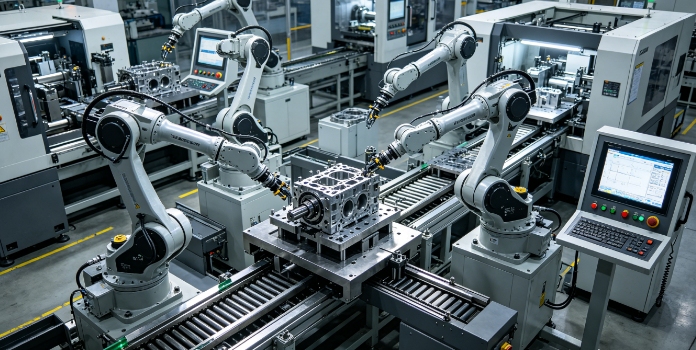
Structural Differences Between 3, 4, and 5 Axis Robot Arm Systems
To understand the advantages of a 5-axis robot arm, it is important to first compare its structure with other systems. Each additional axis increases the robot’s freedom of movement and operational capability.
- 3-axis systems: These robots typically move in X, Y, and Z directions. They are simple, cost-effective, and suitable for basic pick-and-place tasks, but lack rotational flexibility.
- 4-axis systems: In addition to linear movement, a rotation axis is added, allowing limited angular adjustments. This improves handling but still restricts complex orientation tasks.
- 5-axis systems: These include two rotational axes plus three linear axes, enabling highly flexible movement in multiple directions, including complex angles and curved positioning.
- Structural complexity impact: As the number of axes increases, the mechanical design becomes more advanced, requiring precise servo control and stronger programming systems.
This structural evolution makes the 5-axis configuration far more capable in advanced automation scenarios.
Performance Advantages of a 5 Axis Robot Arm in Industry
A 5-axis robot arm offers several performance advantages that make it superior in many industrial applications where precision and flexibility are required.
- Multi-directional movement capability: It can approach workpieces from nearly any angle, making it ideal for complex assembly or molding tasks.
- Higher precision control: Advanced servo systems allow extremely accurate positioning, reducing errors in high-precision manufacturing processes.
- Improved cycle efficiency: By reducing repositioning requirements, the robot completes tasks faster, improving overall production speed.
- Better adaptability: It can handle irregular shapes and complex geometries that simpler systems cannot manage effectively.
- Reduced manual intervention: Automation of complex movements reduces reliance on human adjustment, improving consistency.
These advantages make it a preferred choice in industries requiring advanced automation performance.
Application Scenarios and Industry Suitability
The suitability of a 5-axis robot arm depends heavily on the complexity of the production environment. It is widely used in industries where precision and multi-angle movement are essential.
- Electronics manufacturing: Used for assembling delicate components that require precise positioning and minimal error tolerance.
- Injection molding industry: Helps with inserting, removing, and positioning complex molded parts efficiently.
- Automotive production: Applied in welding, assembly, and component handling tasks that involve multiple angles and orientations.
- Medical equipment manufacturing: Supports production of high-precision devices that demand strict accuracy and cleanliness.
- Packaging automation: Used in advanced labeling, sorting, and stacking systems where flexibility improves efficiency.
In contrast, 3-axis and 4-axis systems are generally limited to simpler, repetitive tasks with fewer positioning requirements.
Cost, Complexity, and Maintenance Considerations
While a 5-axis robot arm offers superior capabilities, it also comes with a higher cost and complexity compared to simpler systems. Manufacturers must evaluate these factors carefully.
- Higher initial investment: Due to advanced structure and control systems, the upfront cost is significantly higher than 3-axis or 4-axis systems.
- More complex programming: Multi-axis coordination requires advanced software and skilled operators for setup and optimization.
- Maintenance requirements: More moving parts mean higher maintenance attention to ensure long-term stability and performance.
- Training needs: Operators must be trained to manage advanced motion control and system calibration.
- Long-term efficiency gains: Despite higher costs, improved productivity and reduced labor often balance long-term investment value.
Therefore, while not always the cheapest option, it often delivers better long-term returns in complex production environments.
Conclusion
In conclusion, whether a 5-axis robot arm is better than a 3-axis or 4-axis system depends on the specific application and production needs. A 5-axis system clearly offers superior flexibility, precision, and efficiency, making it ideal for complex and high-value manufacturing tasks. However, simpler systems may still be more cost-effective for basic operations. For industries requiring advanced automation, multi-angle movement, and high accuracy, the 5-axis solution provides a significant technological advantage and represents a strong investment in modern smart manufacturing.