
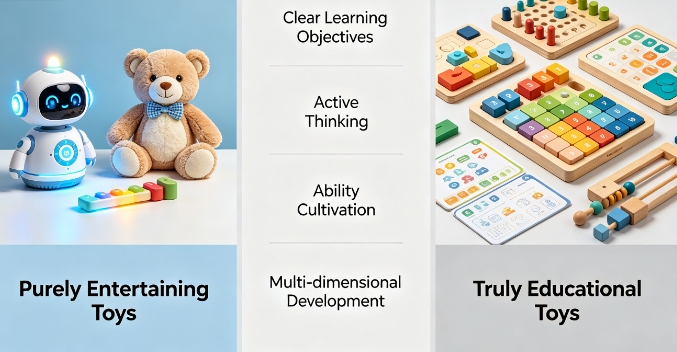
In today’s toy market, many products are labeled as “educational,” but not all of them genuinely contribute to meaningful child development. Bright colors, sounds, and entertaining activities may capture attention quickly, yet true educational value goes much deeper than simple amusement. Parents and educators are becoming more selective when choosing learning tools, focusing not only on entertainment but also on developmental impact. A truly educational toy should help children build practical skills, encourage active thinking, and support long-term cognitive, emotional, and social growth. As competition within the educational toy supplies industry continues to increase, understanding the difference between learning-focused toys and purely entertaining products has become increasingly important.
A toy becomes truly educational when it is designed with a specific developmental goal in mind. Instead of providing random stimulation, it should guide children toward meaningful skill improvement.
Several characteristics help define educational purpose:
Without clear educational goals, a toy may remain entertaining but provide only limited developmental benefits.
One major difference between educational toys and ordinary entertainment products is the level of mental engagement they require. True learning happens when children actively process information and make decisions independently.
For example:
| Passive Entertainment Toys | Educational Learning Toys |
| Focus mainly on visual stimulation | Encourage problem-solving and interaction |
| Provide automatic responses | Requires thinking and decision-making |
| Short-term excitement | Long-term skill development |
| Limited creativity | Open-ended exploration and imagination |
Toys that encourage curiosity, experimentation, and independent thinking help children develop stronger cognitive flexibility and confidence.
A high-quality educational toy often teaches more than one skill at the same time. Rather than focusing on isolated memorization, it supports balanced development across different learning areas.
Important developmental categories include:
Activities involving sorting, matching, sequencing, or construction strengthen logical reasoning and memory.
Interactive storytelling, vocabulary games, and role-play activities improve speaking and comprehension abilities.
Hands-on manipulation develops fine motor control, hand-eye coordination, and movement precision.
Collaborative learning games teach patience, teamwork, emotional regulation, and communication.
Many manufacturers in the educational toy supplies market now focus on creating multifunctional products that combine these learning dimensions into one interactive experience.
A truly educational toy continues to provide value as the child grows. Products with limited interaction may entertain briefly but lose educational relevance quickly.
Key features of long-term educational value include:
Adaptable toys encourage repeated use, which is essential for reinforcing knowledge and building stronger developmental habits.
Educational value is strengthened when toys encourage interaction between children, parents, and teachers. Learning becomes more effective when it includes communication, guidance, and emotional support.
Meaningful interaction can involve:
These interactions help transform simple play into deeper learning opportunities. As educational philosophies continue evolving, the educational toy supplies industry increasingly emphasizes engagement-based learning instead of passive entertainment alone.
A toy becomes truly educational not because of marketing labels or flashy features, but because it actively supports meaningful child development. Effective educational toys encourage thinking, creativity, communication, problem-solving, and emotional growth while adapting to different developmental stages. Unlike products focused only on entertainment, they create opportunities for children to explore, experiment, and learn through active participation. By understanding these qualities, parents and educators can make better decisions when selecting learning tools that provide lasting developmental value rather than temporary amusement.