
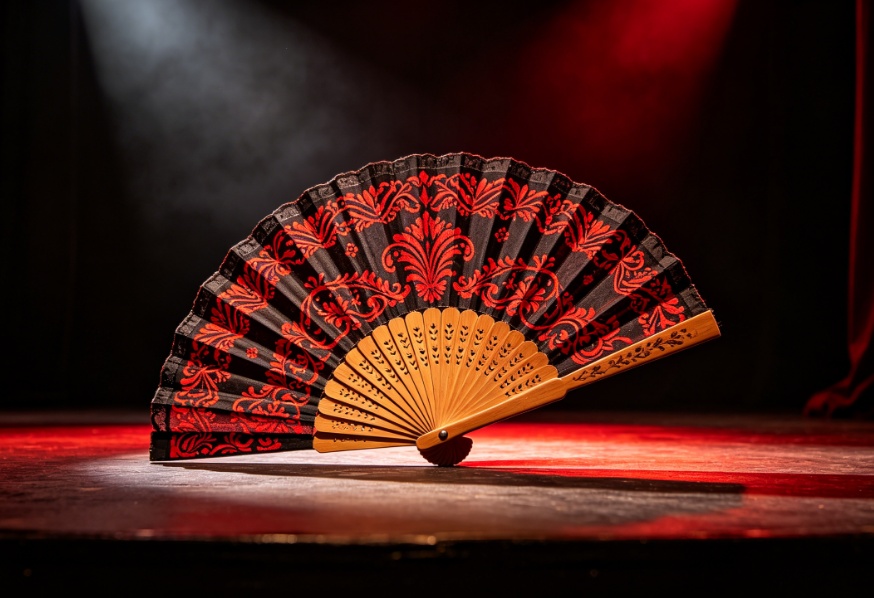
The flamenco hand fan is one of the most recognizable accessories in Spanish culture and dance. While it is often admired for its beauty and elegance, its true significance goes far deeper than appearance. Rooted in history, social customs, and artistic expression, this traditional object carries rich cultural meaning that continues to influence flamenco performances today.
One of the earliest cultural meanings of the flamenco hand fan comes from its use as a silent communication tool. In historical Spanish society, especially in public or formal settings, open expression of emotion was sometimes limited. The fan became a subtle way to convey feelings without words.
Different gestures developed into a kind of “fan language.” For example, slowly opening the fan could indicate interest or attraction, while quickly closing it might signal rejection or disagreement. Through these small but meaningful movements, people were able to express complex emotions discreetly. This tradition laid the foundation for the fan’s symbolic role in cultural performances.
In flamenco performance, the flamenco hand fan transforms into a powerful storytelling instrument. Flamenco is known for its intensity, passion, and emotional depth, and the fan enhances these qualities visually.
Dancers use it to express shifting emotions throughout a performance. A gentle wave may suggest sadness or longing, while sharp, fast movements can represent anger or passion. Because flamenco is deeply emotional, the fan helps translate inner feelings into physical motion, allowing the audience to experience the story more vividly.
Another important cultural meaning of the flamenco hand fan is its association with elegance and femininity. Traditionally, it has been linked to grace, refinement, and social charm. In dance, it complements body movements by adding fluidity and visual rhythm.
The contrast between powerful footwork and delicate hand gestures creates a unique artistic balance. The fan enhances this contrast, highlighting both strength and softness within the same performance. This duality reflects an important aspect of flamenco culture, where emotion and control exist together.
Beyond performance, the flamenco hand fan is also a piece of cultural craftsmanship. Many fans are carefully designed with detailed patterns, hand-painted artwork, or traditional Spanish motifs. These designs often reflect regional identity and artistic heritage.
Each fan can be seen as a small cultural artifact. The materials, colors, and patterns all contribute to its identity, making it more than just a performance tool. In this sense, it represents generations of artistic tradition passed down through Spanish culture, preserving both skill and symbolism.
In addition to emotional and cultural symbolism, the flamenco hand fan plays a practical role in dance rhythm and choreography. Flamenco music is highly structured around rhythm, and dancers often synchronize fan movements with musical beats.
The opening and closing of the fan can emphasize specific accents in the music. This creates a stronger connection between movement and sound, making performances more dynamic. The fan helps structure the visual rhythm of the dance, adding clarity and impact to each sequence.
Today, the flamenco hand fan remains an important symbol of Spanish identity. It is used in festivals, stage performances, cultural exhibitions, and even as a decorative item representing heritage. Its continued presence in both traditional and modern contexts shows its lasting cultural relevance.
Even outside Spain, it is widely recognized as a symbol of flamenco culture and artistic expression. Its ability to connect history with modern performance ensures that its meaning continues to evolve while preserving its traditional roots.
The flamenco hand fan is far more than a decorative object. It represents a rich blend of communication, emotion, artistry, and cultural heritage. From its origins as a silent language tool to its role in modern dance, it continues to carry deep symbolic meaning. Through flamenco performance and cultural tradition, it remains a timeless expression of Spanish identity and artistic storytelling.