
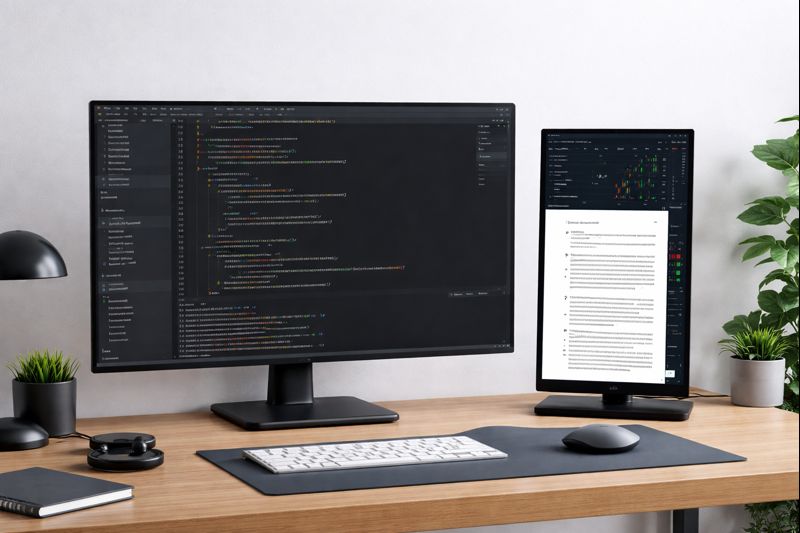
As work styles and digital content continue to evolve, displays are no longer simply about being bigger. Compared with traditional horizontal monitors, a small vertical monitor offers better space efficiency and stronger support for vertically structured information. As a result, it is being adopted by more and more professionals. In multi-monitor setups, content creation workflows, and data monitoring environments, a small vertical monitor can significantly improve productivity with relatively low cost. Below are the most practical and effective use cases for a small vertical monitor.
In programming and software development, a small vertical monitor is a powerful productivity tool. Code is naturally vertical in structure. When used in portrait mode, a vertical monitor can display far more lines of code at once, making functions, logic blocks, and dependencies easier to understand while reducing constant scrolling. This helps developers stay focused and maintain mental flow during long coding sessions. A small vertical monitor is also ideal as a secondary display for:
With the main monitor dedicated to writing code and the vertical screen handling supporting information, developers can work more efficiently—especially in limited desk spaces.
A small vertical monitor excels at document-heavy tasks. Its portrait orientation closely matches paper formats such as A4 or Letter, making it ideal for reading PDFs, contracts, reports, and academic papers. Less zooming and fewer page changes create a more natural reading experience and reduce eye strain during long review sessions. For writing and editing tasks, a vertical monitor works well for:
This setup makes content comparison easier and significantly improves writing efficiency.
With short-form video and mobile-first content becoming dominant, vertical formats are now the standard. This makes a small vertical monitor especially valuable for social media professionals. Common use cases include:
For live streaming or content production, a vertical monitor can also serve as an auxiliary screen for scripts, live chat, or product information, providing a more accurate representation of the end-user viewing experience.
In finance, trading, and data monitoring environments, a small vertical monitor is a cost-effective yet highly efficient solution. Its vertical layout is ideal for displaying:
Often used as an always-on monitoring screen, a small vertical monitor keeps critical information visible without interfering with main-screen tasks.
While large main monitors are essential for design and editing work, a small vertical monitor plays an important supporting role for creative professionals. It is commonly used to:
By moving supporting panels off the main screen, designers can maintain a cleaner workspace and stay focused on creative output.
The growing popularity of the small vertical monitor comes down to several key advantages:
A small vertical monitor is not designed to replace a primary display. Instead, it serves as a highly efficient companion for specific workflows. Its real value lies not in size, but in how well its orientation matches vertically structured content. When your daily work involves code, documents, data tables, or vertical media, integrating a small vertical monitor into your setup can create a cleaner, more efficient multi-screen workflow—without requiring extra desk space or high costs. In display choices, the right layout matters more than a bigger screen.