As industries shift toward automation and smart factories, the demand for highly accurate and flexible robotic systems continues to grow. Among these technologies, the 5 axis robot arm plays an increasingly important role in improving machining accuracy, assembly consistency, and production stability. By offering multiple degrees of freedom and advanced motion control, it allows manufacturers to achieve precision levels that are difficult to maintain with traditional equipment or manual operations.
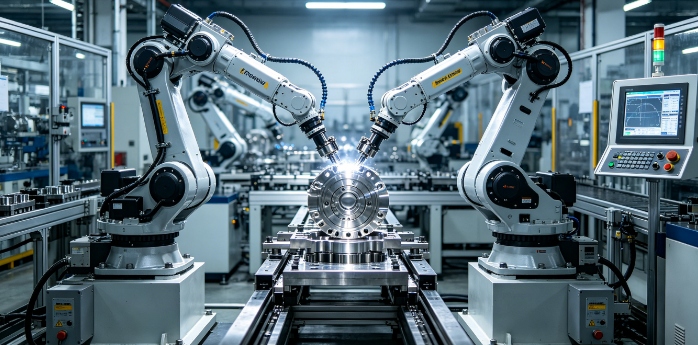
Enhanced Multi-Directional Motion Control
One of the main reasons a 5 axis robot arm improves manufacturing precision is its ability to move across multiple axes simultaneously, allowing for more natural and flexible positioning during complex operations.
- Unlike traditional 3-axis systems that are limited to linear movements, a 5-axis structure adds rotational flexibility, enabling the robot to approach a workpiece from virtually any angle.
- This multi-directional capability reduces the need to reposition materials manually, which often introduces alignment errors or inconsistencies in production.
- In precision machining tasks such as milling or drilling, the robot can maintain optimal tool orientation throughout the entire process, ensuring smoother cuts and more accurate dimensions.
- The ability to adjust angles dynamically also helps maintain consistent contact between tools and materials, which is especially important in high-tolerance manufacturing environments such as aerospace and automotive industries.
This expanded motion range directly reduces geometric limitations and improves overall operational accuracy.
Reduced Human Error and Higher Repeatability
Another major advantage of using a 5 axis robot arm in manufacturing is its ability to eliminate variability caused by human intervention while maintaining consistent output across large production batches.
- Once programmed, the robot performs tasks with identical movement patterns every cycle, ensuring that each product meets the same dimensional standards.
- Human operators may introduce small deviations due to fatigue, judgment differences, or manual handling, but robotic systems maintain stable precision regardless of production volume.
- In repetitive tasks such as component assembly or surface finishing, the system ensures consistent force application and positioning accuracy.
- Advanced calibration systems allow the robot to self-correct minor deviations, further improving long-term repeatability in industrial environments.
This consistency is especially valuable in industries where even microscopic deviations can affect product performance or safety.
Advanced Sensor Integration and Real-Time Adjustment
Precision manufacturing today is not only about mechanical accuracy but also about intelligent feedback and real-time correction. A 5 axis robot arm often integrates sensors that significantly enhance its decision-making and positioning accuracy.
- Vision systems allow the robot to identify object position, orientation, and surface conditions before executing tasks, ensuring correct alignment.
- Force sensors help regulate pressure during assembly or polishing, preventing over-application that could damage delicate components.
- Real-time feedback loops enable the robot to adjust its movements dynamically if deviations are detected during operation.
- Thermal and vibration monitoring systems can further stabilize performance by compensating for environmental changes in the production line.
These smart integrations transform the robot from a static machine into an adaptive precision system capable of responding to real-world variations.
Improved Tool Path Optimization and Process Stability
A 5 axis robot arm also enhances precision by optimizing tool paths and maintaining stable processing conditions throughout manufacturing operations.
- The system calculates the most efficient movement paths to reduce unnecessary motion, which minimizes vibration and improves accuracy.
- Continuous tool attitude control ensures that the cutting tool or assembly tool maintains an optimal angle, thereby reducing wear and enhancing surface quality.
- In high-speed production environments, optimized motion planning reduces sudden stops or directional changes that could introduce mechanical instability.
- Advanced control algorithms help synchronize multiple axes smoothly, preventing jerks or inconsistencies during complex operations.
As a result, manufacturers benefit from cleaner finishes, tighter tolerances, and more predictable production outcomes.
Greater Flexibility for Complex Product Designs
Modern product designs are becoming increasingly complex, requiring manufacturing systems that can maintain precision across irregular shapes and multi-angle surfaces. The 5 axis robot arm is particularly effective in addressing this challenge.
- It can handle curved, angled, or irregular geometries without sacrificing accuracy, making it suitable for advanced industrial applications.
- Multi-surface processing allows the robot to complete multiple operations in a single setup, reducing repositioning errors.
- It supports high-precision work in industries such as medical device manufacturing, aerospace components, and precision electronics.
- The flexibility of movement ensures that even intricate structures can be processed consistently without manual adjustment.
This adaptability significantly expands the range of manufacturable products while maintaining rigorous precision standards.
Conclusion
The 5 axis robot arm significantly improves precision in manufacturing processes by combining advanced motion control, high repeatability, intelligent sensing, optimized tool paths, and exceptional flexibility for complex designs. These capabilities allow manufacturers to achieve tighter tolerances, higher consistency, and improved production efficiency across a wide range of industries. As smart manufacturing continues to evolve, the role of multi-axis robotic systems will become even more critical in delivering high-precision, scalable, and reliable industrial production solutions.