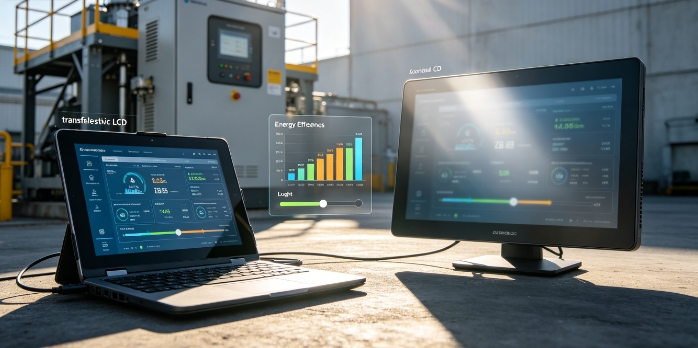
The transflective LCD is often discussed as an energy-efficient alternative to traditional LCD screens, especially in applications where devices must operate for long hours on limited power sources. Unlike standard LCDs that rely heavily on constant backlighting, this display technology combines reflective and transmissive modes, allowing it to use ambient light in bright environments and reduce backlight usage. As a result, it has become a popular choice in portable devices, outdoor instruments, and industrial equipment. However, whether it is truly better than traditional LCDs in terms of power efficiency depends on usage conditions, screen design, and environmental lighting. To fully understand the comparison, it is necessary to examine how both technologies consume energy in different scenarios and where each one performs best.
How Power Consumption Differs Between the Two Technologies
The biggest difference between a transflective LCD and a traditional LCD lies in how they use backlighting, which directly affects energy consumption.
- Traditional LCD dependence on backlight: Standard LCDs require continuous and strong backlighting regardless of ambient light, which leads to higher and more constant power usage.
- Adaptive light usage in transflective design: The transflective version reduces backlight intensity when natural light is sufficient, lowering overall energy consumption.
- Brightness adjustment behavior: Traditional screens often maintain fixed brightness levels, while transflective displays dynamically balance reflected light and backlight support.
- Efficiency in bright environments: In outdoor conditions, the transflective design may use little to no backlight, significantly reducing power demand.
From a technical perspective, this adaptive lighting system gives the transflective LCD a clear advantage in environments with strong ambient light.
Situations Where Transflective LCD Saves More Energy
Power efficiency benefits become especially noticeable in real-world outdoor or semi-outdoor usage scenarios.
Key energy-saving situations include:
- Outdoor handheld devices
Devices like GPS units and field scanners can rely heavily on sunlight reflection, reducing backlight usage and extending battery life.
- Industrial field equipment
Machinery control panels used in bright environments require minimal backlight, helping conserve energy during long working hours.
- Mobile navigation systems
When exposed to sunlight, these screens can operate at lower brightness settings while maintaining readability.
- Emergency and military tools
Field devices benefit from reduced power drain, which is critical in situations where charging is not available.
In these cases, the transflective LCD clearly demonstrates superior energy-saving performance compared to traditional LCDs.
Limitations in Low-Light and Indoor Environments
Despite its advantages, the transflective LCD does not always outperform traditional LCDs in terms of power efficiency.
- Higher backlight reliance indoors: In low-light conditions, it still requires backlighting similar to standard LCDs, reducing its energy advantage.
- Reduced efficiency gains at night: Without ambient light, the reflective function becomes less useful, and power consumption increases.
- Complex display structure: The hybrid design may introduce slight inefficiencies in certain display configurations.
- Performance depends on lighting conditions: Energy savings are not consistent across all environments, unlike optimized low-power traditional LCD panels.
This means that while it excels outdoors, its efficiency advantage is context-dependent rather than universal.
Additional Factors That Influence Power Efficiency
Beyond display technology itself, several external and design-related factors affect energy consumption.
- Screen size and resolution: Larger and higher-resolution displays naturally consume more power regardless of type.
- Backlight quality and LED efficiency: Modern traditional LCDs with advanced LED backlights can narrow the efficiency gap.
- User brightness settings: Manual brightness control can significantly change real-world power usage patterns.
- Device usage behavior: Continuous screen-on time versus intermittent use affects total energy consumption more than display type alone.
These factors show that power efficiency is not determined solely by display technology but also by how the device is designed and used.
Conclusion
In terms of power efficiency, the transflective LCD generally performs better than traditional LCDs in bright or outdoor environments because it reduces dependence on backlighting and utilizes ambient light effectively. However, its advantage diminishes in low-light conditions, where both technologies rely on backlighting to function properly. Traditional LCDs, especially modern energy-optimized versions, can sometimes match or even approach the efficiency of similar indoor usage. Overall, the transflective LCD is more energy-efficient in specific use cases rather than universally superior, making it an excellent choice for outdoor, portable, and industrial applications where lighting conditions vary frequently.