In industrial automation and precision manufacturing, linear actuators play a key role in system efficiency, accuracy, and long-term reliability. As applications demand higher speed, greater precision, and improved automation, the performance limitations of conventional solutions have become more evident. As a result, the linear motor actuator has attracted growing attention for its direct-drive design, high dynamic performance, and low maintenance requirements.
At the same time, traditional linear actuators remain widely used due to their mature technology, strong load capacity, and cost-effectiveness. Understanding the differences between a linear motor actuator and a traditional linear actuator is therefore essential for selecting the most appropriate solution.
What Is a Linear Motor Actuator?
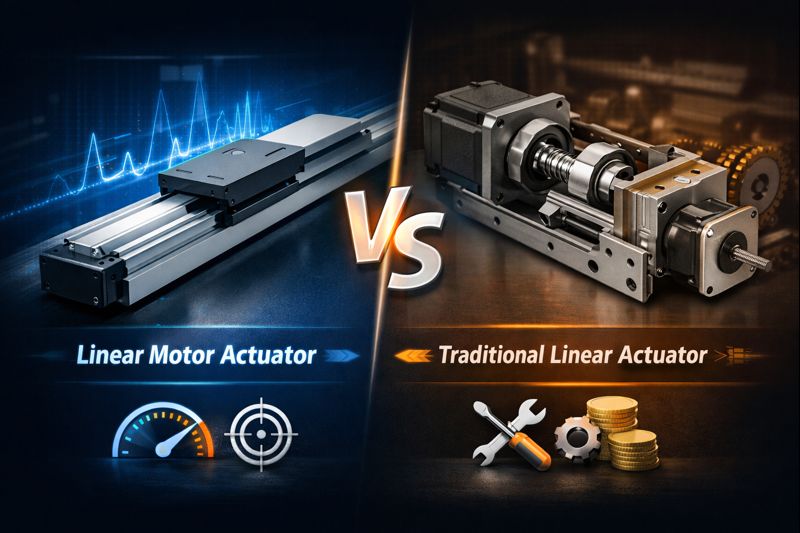
A linear motor actuator is a high-performance motion device based on linear motor technology. Its defining characteristic is direct drive, meaning electrical energy is converted directly into linear motion without the use of mechanical transmission components such as ball screws, belts, or gears. This significantly shortens the motion transmission path and minimizes energy loss and accumulated mechanical error.
Because there is no mechanical backlash or friction from transmission elements, a linear motor actuator can achieve extremely high positioning accuracy and repeatability. It also maintains smooth and stable motion even at high speeds or during frequent start-stop cycles, making it ideal for applications that demand superior precision and dynamic performance.
Basic Form of a Traditional Linear Actuator
A traditional linear actuator typically consists of a rotary motor combined with a mechanical transmission system. Linear motion is generated by converting rotary motion through components such as ball screws, belts, or rack-and-pinion mechanisms. These systems have been developed and refined over decades and are highly standardized and well understood.
Traditional linear actuators are known for their strong load capacity, structural robustness, and relatively low initial cost. As a result, they continue to be the preferred choice in general automation, heavy-duty machinery, and cost-sensitive industrial applications.
Differences in Operating Principle and Structure
- Linear motor actuator:
The actuator operates using a direct-drive structure, where the linear motor itself generates motion. Because there are no intermediate mechanical conversion components, the system is more compact and rigid, with significantly reduced vibration and mechanical error. This directly improves overall motion accuracy and system responsiveness.
- Traditional linear actuator:
Motion relies on mechanical transmission components to convert rotary motion into linear displacement. While this approach is proven and reliable, the presence of multiple moving parts introduces mechanical backlash, elastic deformation, and transmission losses, all of which can negatively affect precision and dynamic performance.
Accuracy and Repeatability Comparison
- Linear motor actuator:
With no mechanical backlash or transmission error, linear motor actuators can achieve positioning and repeatability at the micrometer level or better. Even after long-term continuous operation, accuracy remains highly stable, making them ideal for precision machining, inspection, and positioning systems.
- Traditional linear actuator:
Positioning accuracy is influenced by factors such as screw clearance, bearing wear, and lubrication condition. Over time, mechanical wear may gradually reduce accuracy, making traditional linear actuators more suitable for applications with moderate precision requirements.
Speed, Acceleration, and Dynamic Performance
- Linear motor actuator:
Linear motor actuators offer exceptionally high speed and acceleration, enabling rapid start-stop motion and high-frequency reciprocating movement while maintaining smooth operation. These characteristics make them well-suited for high-speed sorting, precision assembly, and high-throughput automated production lines.
- Traditional linear actuator:
Speed and acceleration are limited by the mechanical transmission system. At higher speeds, vibration, noise, and resonance may occur, which restricts their suitability for applications requiring high dynamic performance.
Maintenance Requirements and Service Life
- Linear motor actuator:
With minimal mechanical contact and friction, maintenance requirements are extremely low. Reduced need for lubrication and fewer wear components result in less downtime and lower long-term operating costs, making linear motor actuators ideal for continuous-operation and high-reliability environments.
- Traditional linear actuator:
Regular maintenance is required for screws, bearings, and lubrication systems. In high-duty-cycle or heavy-load conditions, maintenance intervals may be shorter, leading to higher long-term maintenance costs and increased downtime.
Cost and Load Capacity Considerations
- Linear motor actuator:
Initial investment costs are generally higher, and additional requirements for motion control, feedback devices, and thermal management must be considered. In heavy-load or very long-stroke applications, cost advantages may be limited, requiring careful evaluation of total return on investment.
- Traditional linear actuator:
Traditional actuators offer lower upfront costs and excellent load-handling capability. Their robust design makes them a cost-effective solution for applications that prioritize force output and budget control.
Linear Motor Actuator vs Traditional Linear Actuator
| Comparison Aspect |
Linear Motor Actuator |
Traditional Linear Actuator |
| Drive method |
Direct drive, linear motion generated directly by the motor |
Rotary motor with mechanical transmission |
| Mechanical structure |
Simple, minimal mechanical components |
More complex, includes screws or belts |
| Positioning accuracy |
Extremely high, micrometer-level or better |
Moderate, affected by mechanical backlash |
| Repeatability |
Highly stable over long-term operation |
May degrade over time due to wear |
| Speed & acceleration |
Very high, suitable for high-speed motion |
Limited by the mechanical structure |
| Maintenance |
Very low, little to no lubrication required |
Regular maintenance and lubrication needed |
| Initial cost |
Higher |
Lower |
| Typical applications |
High-precision, high-speed, high-dynamic systems |
Heavy-duty, general-purpose, cost-sensitive systems |
Application Suitability Analysis
- Linear motor actuator:
Best suited for industries such as semiconductor manufacturing, precision inspection, laser processing, high-speed sorting, and medical or optical equipment, where accuracy, speed, and dynamic response are critical.
- Traditional linear actuator:
More suitable for heavy industrial equipment, general automation lines, and applications where speed and precision demands are moderate but reliability and cost efficiency are key considerations.
Conclusion
How Does a Linear Motor Actuator Differ from a Traditional Linear Actuator?
The fundamental difference lies in the trade-off between the high performance, precision, and low maintenance enabled by direct drive, and the cost efficiency and load capacity provided by mechanical transmission systems. As automation systems continue to advance, the linear motor actuator is becoming an increasingly important solution for high-end applications, while the traditional linear actuator remains a reliable and economical choice across a wide range of industrial environments.