
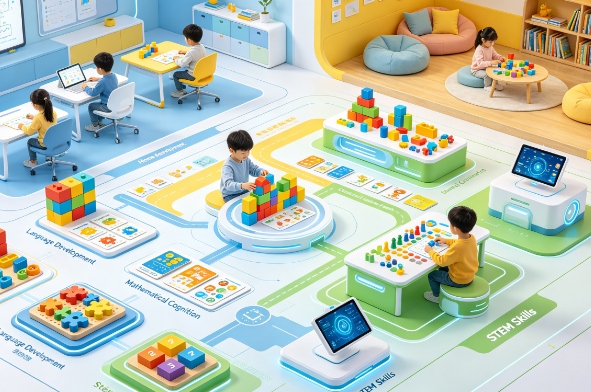
In recent years, early childhood education has undergone a major transformation as parents and educators increasingly move away from purely lecture-based or memorization-focused teaching methods. Instead, learning through play has gained strong attention for its ability to combine enjoyment with meaningful skill development. Among these approaches, educational toy-based learning is becoming a central topic of discussion worldwide. Many schools and institutions are now exploring how structured play tools can complement or even reshape traditional teaching models. As global demand continues to grow, the educational toy supplies market is also expanding rapidly, reflecting a shift in how early education is designed and delivered. This raises an important question: could educational toy learning eventually become the new standard in early education?
Play-based learning has become a major educational trend because it aligns closely with how young children naturally explore the world. Instead of passive listening, children learn best through hands-on interaction, discovery, and experimentation.
Key factors driving this shift include:
This growing acceptance of play-based learning has created a strong foundation for educational toys to play a larger role in early education systems.
Educational toys offer a wide range of benefits that support cognitive, emotional, and physical development simultaneously. Their structured yet flexible nature makes them highly suitable for early learners.
Important advantages include:
Interactive learning tools encourage children to solve problems, recognize patterns, and develop logical thinking abilities through engaging activities.
Through trial-and-error play, children learn patience, resilience, and emotional control when facing challenges or mistakes.
Group-based educational toys promote cooperation, sharing, and verbal expression among children in both home and classroom environments.
Hands-on manipulation of learning tools enhances fine motor skills, hand-eye coordination, and spatial awareness.
With increasing demand for structured learning tools, the educational toy supplies industry continues to develop more advanced products that combine multiple learning outcomes in one system.
Although educational toy learning offers many advantages, it is unlikely to completely replace traditional teaching methods in the near future. There remain several limitations that must be taken into consideration.
Key challenges include:
Because of these challenges, educational toy learning is more realistically viewed as a complementary system rather than a complete replacement.
Modern educational toys are increasingly incorporating digital technologies, making them more interactive and adaptive than ever before. This technological integration is one of the main reasons for their growing popularity.
Key technological developments include:
These innovations are transforming traditional play into intelligent learning experiences. As a result, many suppliers within the educational toy supplies sector are focusing on hybrid products that combine physical toys with digital learning environments.
The future of early education is likely to involve a blended learning model rather than a complete shift away from traditional methods. However, educational toys are expected to play a significantly larger role than before.
Key future trends include:
Rather than replacing teachers, educational toys are more likely to become essential support tools that enhance teaching effectiveness and improve student engagement.
Educational toy-based learning is rapidly transforming the landscape of early childhood education. While it may not fully replace traditional teaching methods, it is clearly becoming an essential component of modern learning systems. By combining play, interaction, and structured skill development, educational toys offer a powerful approach to engaging young learners. With continued innovation and growing demand across the educational toy supplies industry, these tools are likely to become a standard feature in early education environments, working alongside traditional methods to create a more balanced and effective learning experience for children.