In recent years, display technology has evolved rapidly, moving beyond traditional flat screens toward more immersive visual experiences. Among these innovations, the glasses free 3d display stands out as a breakthrough that allows users to experience three-dimensional visuals without wearing special eyewear. By using advanced optical techniques such as lenticular lenses or parallax barriers, this technology delivers depth perception directly to the naked eye. As a result, it is increasingly being adopted in entertainment, education, advertising, and professional visualization. Understanding the main advantages of a glasses free 3d display helps explain why it is becoming an important trend in modern visual technology.
More Natural and Comfortable Viewing Experience
One of the biggest advantages of a glasses free 3d display is the ability to provide a more natural and fatigue-free viewing experience compared to traditional 3D systems.
- No need for special glasses: Users can view 3D content directly without wearing additional accessories, improving convenience in daily use.
- Reduced eye strain: Eliminating 3D glasses helps reduce discomfort caused by prolonged wear, making long viewing sessions more comfortable.
- More immersive perception: Depth and spatial effects appear directly on the screen, creating a more realistic visual experience.
- Easier audience engagement: Viewers can immediately enjoy 3D content without setup or calibration, improving accessibility in public environments.
This natural viewing method makes the glasses free 3d display especially suitable for exhibitions, retail spaces, and public installations.
Enhanced Interaction and User Engagement
Another key advantage of a glasses free 3d display is its ability to improve interaction and engagement across various applications.
- Stronger visual impact:3D depth effects make content more visually striking, capturing attention more effectively than flat displays.
- Improved information delivery: Complex data, models, or designs can be presented in a more intuitive three-dimensional format.
- Better audience retention: Users are more likely to remember visually immersive content, increasing communication effectiveness.
- Interactive potential: Many systems allow touch or gesture-based interaction combined with 3D visuals for a more dynamic experience.
These features make the technology highly valuable in advertising, product demonstrations, and digital signage applications.
Greater Convenience and Accessibility in Daily Use
The glasses free 3d display also offers significant practical advantages that improve usability in real-world environments.
- Simple setup process: Users do not need to distribute or manage additional viewing equipment like 3D glasses.
- Multi-user support: Multiple people can view the same 3D content simultaneously from suitable angles.
- Reduced maintenance requirements: Without wearable devices, there is less need for cleaning, replacement, or charging.
- Broader accessibility: Ideal for public spaces where providing glasses to every viewer would be impractical.
This convenience makes the technology more scalable and suitable for commercial deployment in busy environments.
Applications in Education, Design, and Visualization
A major strength of the glasses free 3d display lies in its ability to improve understanding and visualization across professional fields.
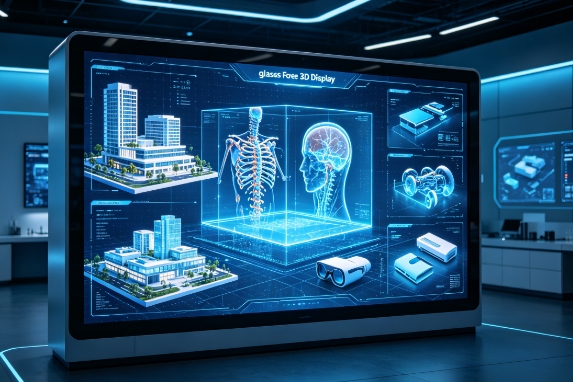
- Education and training: Complex subjects such as anatomy, engineering structures, and physics models can be displayed in 3D, helping students grasp concepts more easily.
- Product design and prototyping: Designers can view models in realistic depth, improving evaluation and decision-making during development stages.
- Medical visualization: Doctors and researchers can analyze imaging data more intuitively using spatial depth representation.
- Architectural presentation: Building designs and urban planning models become easier to interpret in three-dimensional space.
These use cases demonstrate how the technology enhances clarity and reduces misunderstanding in visual communication.
Limitations and Practical Considerations
Although the glasses free 3d display offers many advantages, there are still some limitations that users should consider.
- Viewing angle restrictions: Optimal 3D effects may only be visible within specific angles or positions.
- Higher production cost: Advanced optical structures and hardware increase manufacturing complexity and price.
- Resolution trade-offs: Some systems may reduce effective resolution when generating 3D effects.
- Content compatibility: Not all media is originally designed for glasses-free 3D rendering.
These factors mean that while the technology is powerful, it is not yet a complete replacement for traditional display systems in every scenario.
Conclusion
In conclusion, the glasses free 3d display offers significant advantages for users, including a more natural viewing experience, improved engagement, greater convenience, and strong applications across education, design, and commercial industries. Eliminating the need for special eyewear, it makes 3D content more accessible and practical in everyday use. However, challenges such as viewing angle limitations and cost still exist. Overall, this technology represents an important step forward in display innovation, delivering immersive visual experiences that are increasingly shaping the future of digital interaction.