

Choosing the correct lenses for your glasses is as important as choosing the correct frames because both determine not only your appearance but also your degree of comfort throughout the day. High index lenses are favored by most people with stronger prescriptions because they are thinner and lighter, and more fashionable than regular lenses. They tend to reduce the “thick lens” appearance and match existing frame fashions. But before finalizing your decision, it is a good idea to inquire: what are the high index lenses disadvantages, and do the advantages really outweigh the possible disadvantages for your needs and lifestyle, and eyesight requirements?
High index glasses are constructed from new materials that are better at bending light than the normal plastic or glass. As less material is used to deliver the same prescription, the glasses are extremely thin and light in comparison to other glasses. They are not only more comfortable when worn daily, but they also make your glasses look better optically. They are not only more comfortable to wear daily, but they also make your glasses look better visually. They are particularly preferred by people with high prescriptions but who do not want the “thick glasses” appearance and would prefer a more streamlined, modern appearance that will be suitable to many frame styles.
Appearance is one of the primary reasons people choose high index lenses. Unlike standard lenses, they look thinner without high prescriptions, thus avoiding the “magnified” or “miniaturized” eye appearance.
Thin lenses are equivalent to lighter weight on your nose and ears. This is more comfortable to wear all day, especially if you wear them for long periods of time.
Being thinner, high index glasses are suitable for a wide variety of frame styles, including rimless and semi-rimless frames.
Most high index lenses are themselves UV-blocking, so no additional UV coating is required. That’s an additional plus in protecting your eyes from further sun damage.
High index lenses are more expensive than regular plastic or polycarbonate lenses. To price-conscious buyers, that added cost is a drawback.
Though robust enough to be worn every day, high index lenses are not as impact-resistant as polycarbonate.
Some high index materials possess a lower Abbe value, i.e., how well the lens focuses light dispersion. This will cause minor chromatic aberrations—such as fringing colors—especially perceptible in the peripheral areas.
High index lenses also reflect more light since they refract light. Without an anti-reflective (AR) coating, you could be bothered by irritating glare, especially while driving at night or looking at electronic screens.
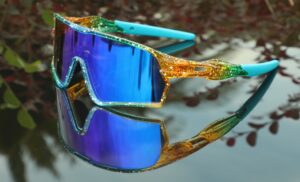
Whereas standard lenses do have a very wide range of tints, gradients, and sports colors, high index lenses are more limited in the amount of personalization they can allow. This should be something you keep in mind if you are searching for specialty lenses to wear outdoors.
High index lenses are a top seller among those who have strong prescriptions and who desire glasses that are lighter, thinner, and trendy. They’re especially appealing if you’re not keen on the blocky appearance of regular lenses. Just make certain to weigh the high index lenses disadvantages, however—such as higher cost, diminished impact protection, and potential glare—before you do. If your prescription is small enough, the differential in thickness may be too small to make the added cost worthwhile. Conversely, where price sensitivity or durability is a concern, polycarbonate lenses or simple plastic lenses would be more convenient and budget-friendly for daily wear.
Having knowledge of high index lenses disadvantages and pros allows you to make a more informed choice for your eyeglasses. They are slender, light, and fashion-chic, but costlier, with potential visual distortion, and less rugged. Your prescription level, way of living, and budget determine the best choice.